
What Does “Return to Sport” Actually Mean?
Tue, 29 Sep 2026

Follow the stories of academics and their research expeditions
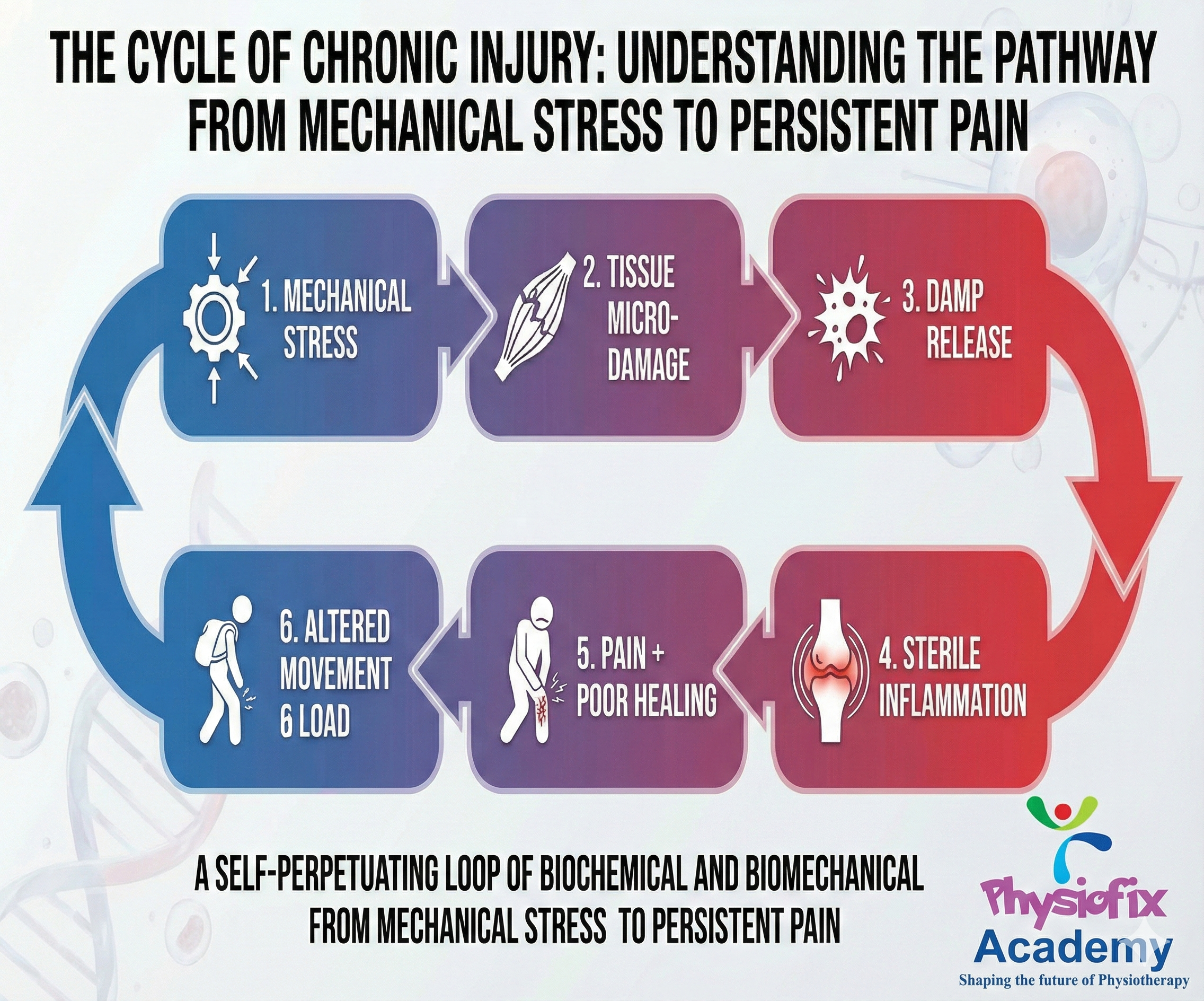
Joint degeneration, especially conditions like osteoarthritis, has long been explained as a simple problem of wear and tear. However, modern research clearly shows that degeneration is not just mechanical. It is a biological and inflammatory process, and one of the earliest drivers of this process is something called sterile inflammation, initiated by DAMPs.
Understanding this mechanism helps clinicians, students, and patients appreciate why joints degenerate, why pain appears early, and why physiotherapy plays a critical role beyond exercises alone.
Sterile inflammation refers to inflammation occurring in the absence of infection.
No bacteria
No virus
No external pathogen
Yet, the joint shows:
Pain
Swelling
Stiffness
Progressive degeneration
This type of inflammation is commonly seen in:
Osteoarthritis
Tendinopathy
Disc degeneration
Overuse injuries
The trigger for sterile inflammation is internal danger signals, known as DAMPs.
DAMPs (Damage-Associated Molecular Patterns) are molecules released from damaged or stressed cells and tissues.
Under normal conditions, these molecules are:
Safely hidden inside cells, or
Part of intact joint structures
When tissue damage occurs, these molecules are released or fragmented, and the body interprets them as a sign of danger.
In simple terms:
The joint mistakes internal damage for a threat and switches on inflammation.
How Do DAMPs Get Released in a Joint?
Joint tissues experience continuous mechanical stress from:
Repetitive loading
Poor movement patterns
Malalignment
Obesity
Aging
This causes micro-damage, not always visible on X-rays.
Sources of DAMPs in a Joint
1. From Cartilage Matrix Breakdown
Collagen fragments – loss of tensile strength
Aggrecan fragments – reduced shock absorption
Hyaluronic acid fragments – loss of lubrication
When intact, these molecules are protective.
When fragmented, they become inflammatory signals.2. From Injured or Dying Cells
Extracellular ATP – strong danger alarm
HMGB1 – released from damaged cell nuclei
Heat shock proteins – protective inside cells, inflammatory outside
How Does the Joint Detect DAMPs?
Joint cells are not passive. They actively monitor their environment using Pattern Recognition Receptors (PRRs).
Important PRRs in joints include:
Toll-like receptors (TLR-2, TLR-4)
NOD-like receptors
These receptors are found on:
Chondrocytes
Synoviocytes
Synovial macrophages
Once DAMPs bind to these receptors, a key sequence begins:
DAMPs → PRRs → Signaling ON
What Happens When Signaling Turns ON?
Activation of PRRs triggers intracellular inflammatory pathways such as:
NF-κB
MAP kinase pathways
This leads to increased production of:
Pro-inflammatory cytokines (IL-1β, TNF-α, IL-6)
Cartilage-degrading enzymes (MMPs, ADAMTS)
The joint environment shifts from repair mode to breakdown mode.
Effects of Sterile Inflammation in the Joint
1. Synovial Irritation (Synovitis)
Thickening of synovial lining
Increased blood flow
Release of more inflammatory mediators
The synovium is highly pain-sensitive, making it a major source of joint pain.
2. Joint Effusion
Excess synovial fluid production
Increased intra-articular pressure
Reflex muscle inhibition
This explains reduced muscle activation, such as quadriceps inhibition in knee osteoarthritis.
3. Pain Sensitization
Cytokines lower pain threshold of nerve endings
Normal movements become painful
With chronic inflammation:
Central sensitization may develop
Pain persists even with minimal structural damage
This is why pain severity does not always match X-ray findings.
4. Reduced Cartilage Healing
Healthy cartilage repair requires a low-inflammatory environment.
Sterile inflammation:
Inhibits collagen and proteoglycan synthesis
Promotes chondrocyte apoptosis and senescence
Reduces the joint’s ability to self-maintain
Over time, degeneration accelerates.
Key Takeaway
Sterile inflammation driven by DAMPs is the biological starting point of joint degeneration, explaining early pain, synovitis, and progressive cartilage breakdown even in the absence of infection.
Tue, 29 Sep 2026

Master physiotherapy from the comfort of your home with expert-led courses

Leave a comment