
What Does “Return to Sport” Actually Mean?
Tue, 29 Sep 2026

Follow the stories of academics and their research expeditions
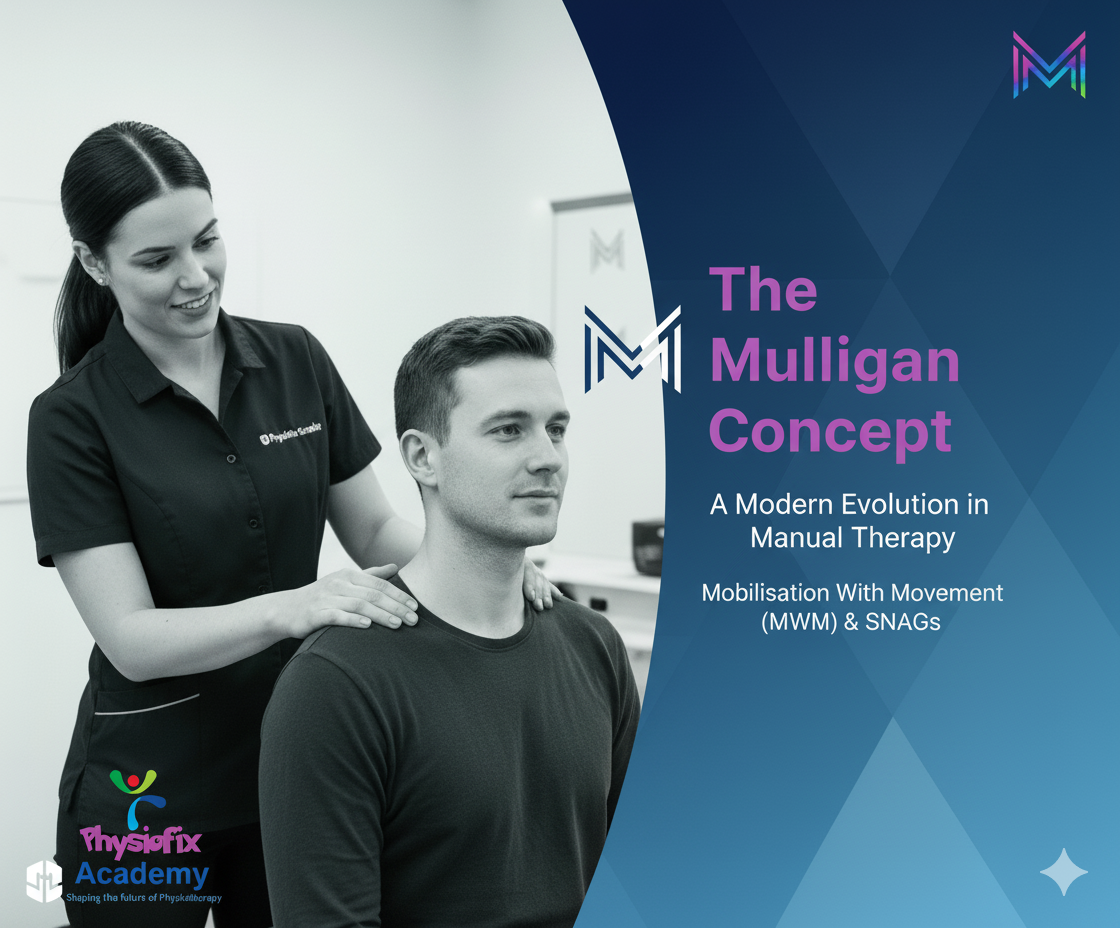
Manual therapy has always been shaped by people who were not satisfied with what already existed — clinicians who asked better questions and observed what others overlooked. One such figure is Brian R. Mulligan, a New Zealand physiotherapist whose work fundamentally shifted how we approach pain, movement, and joint dysfunction. His pioneering approach, known globally as the Mulligan Concept, introduced the idea of Mobilisation With Movement (MWM) and SNAGs, techniques that continue to influence physiotherapy practice worldwide.
This blog explores the history, inspiration, and scientific reasoning behind his work.
Brian Mulligan qualified as a physiotherapist from the New Zealand School of Physiotherapy in 1954. Early in his career, he worked in private practice in Wellington, where he treated patients presenting with a wide spectrum of musculoskeletal pain.
However, the physiotherapy landscape during the 1950s–1970s relied heavily on:
Passive mobilizations
Heat and electrotherapy
Rest and generalized exercise
Although these methods helped many, some patients showed only temporary improvement. Symptoms would often return within hours or days. Mulligan, like many clinicians, felt there had to be a simpler and more immediate way to restore function.
Mulligan did not create his method in isolation. His thinking evolved in the environment shaped by manual therapy pioneers:
| Pioneer | Key Contribution | Influence on Mulligan |
|---|---|---|
| Freddy Kaltenborn | Accessory joint glides, arthrokinematics | Helped Mulligan understand joint positional faults |
| Geoffrey Maitland | Graded oscillatory mobilization and symptom-response | Reinforced the importance of immediate clinical feedback |
| Robin McKenzie | Patient-driven repeated movements | Inspired Mulligan’s shift toward active movement during treatment |
Mulligan absorbed these concepts — but then challenged their limits.
By the late 1970s, Mulligan had begun teaching manual therapy and had already completed his Diploma in Manipulative Therapy (1974). Yet clinically, something bothered him:
Why did some joints move poorly even when structurally intact?
This led him to explore what he later called:
The idea that after an injury or strain, a joint might not be in the ideal mechanical alignment, even though it is not dislocated or visibly altered.
This subtle misalignment could:
Alter joint mechanics
Restrict motion
Trigger pain during movement
But most importantly:
If the alignment is corrected manually, movement can become instantly pain-free.
The turning point came during a routine clinical session. Mulligan applied a gentle lateral glide to a patient’s painful finger joint while the patient actively moved it.
To his surprise — the pain reduced immediately.
Not 6 sessions later.
Not after complicated strengthening programs.
Instantly.
This single observation sparked the core philosophy of what became:
Therapist applies a corrective joint glide → Patient performs the painful movement → Movement becomes pain-free and restored.
This was a radical departure from passive-only manual therapy.
Once MWM principles were established for peripheral joints, Mulligan extended the idea to the spine.
He developed Sustained Natural Apophyseal Glides (SNAGs) — gentle, sustained facet joint glides performed while the patient moves themselves.
SNAGs became clinically powerful for:
Neck pain (especially rotation loss)
Low back stiffness
Rib and thoracic mobility dysfunction
Functional movement restoration
The key characteristic remains:
✅ Symptom-free movement during correction
By the early 1980s, Mulligan began teaching internationally.
By the 1990s, research studies on MWMs and SNAGs were emerging.
In 1989/1995 onward, his textbook Manual Therapy: NAGS, SNAGS, MWMs, etc. was published and translated widely.
Over the next decades:
Mulligan teaching associations formed worldwide
Certification pathways were established
Universities integrated MWM into postgraduate programs
Systematic reviews confirmed positive effects for multiple musculoskeletal conditions
Today, the Mulligan Concept is taught in:
Physiotherapy programs
Manual therapy specialization courses
International conference workshops
In a clinical world filled with machines, protocols, and passive treatment, Mulligan brought focus back to:
His method restored confidence — both in patients and clinicians.
| Principle | Meaning | |
|---|---|---|
| Pain-Free Treatment | If pain appears — technique stops. | |
| Immediate Effect | If alignment is corrected, movement improves instantly. | |
| Active Participation | The patient moves, not just the therapist. | |
| Repeatability | Effects must be reproducible during the session. |
This is not just manual therapy.
It is clinical reasoning + touch + movement.
Brian Mulligan did not simply create a technique —
he created a shift in thinking.
He showed the world that:
Pain is not only about damage
Movement is not only mechanical
The body can respond to the right manual cue — instantly
Today, every time a therapist performs an MWM or SNAG, they are practicing more than a technique — they are continuing a legacy of innovation, curiosity, and compassion in manual therapy.
Tue, 29 Sep 2026
Master physiotherapy from the comfort of your home with expert-led courses

Leave a comment